 Coinmarketcap
Coinmarketcap portfolio gains depend on recorded cost basis
· last updated
Coinmarketcap calculates portfolio gains by comparing recorded acquisition costs with sale proceeds and the market value of remaining holdings. Realized profit belongs to recorded sales; unrealized profit belongs to assets still held. Buying fees increase acquisition costs, and selling fees reduce sale proceeds. A rising coin price doesn’t establish whether your own position is profitable. Purchases at different prices give each portfolio its own starting point. Accurate quantities establish what the holdings are worth, while accurate transaction records establish their gains. Missing purchase history can leave the balance looking plausible even when the profit figure is misleading.
Transaction records, holdings, and market prices
A portfolio combines transaction records with tracked holdings and market prices to calculate the value and performance of recorded assets. Purchase and sale entries supply quantities, execution prices, and fees. The holdings record describes what’s left, while market prices value those units now. Manual entries give direct control over transaction fields. Supported address and exchange connections offer another way to bring holdings into the tracker. A balance alone doesn’t establish the amount originally paid, so automatic holdings updates and complete acquisition records answer different questions.
A watchlist follows selected assets without acquisition records. Portfolio gain calculations need the additional ownership and cost information.
Complete purchase history and acquisition costs
Purchase history establishes the cost side of portfolio gains, so missing acquisition details can distort an otherwise accurate holdings total. A manually entered buy accepts asset quantity, price per coin, date and time, transaction fees, and an optional note. The unit price should describe the actual purchase. A suggested market price in an entry form isn’t proof of that execution price. The trade record provides the historical amount paid. Notes can preserve context, while the saved quantity and cost fields drive the arithmetic.
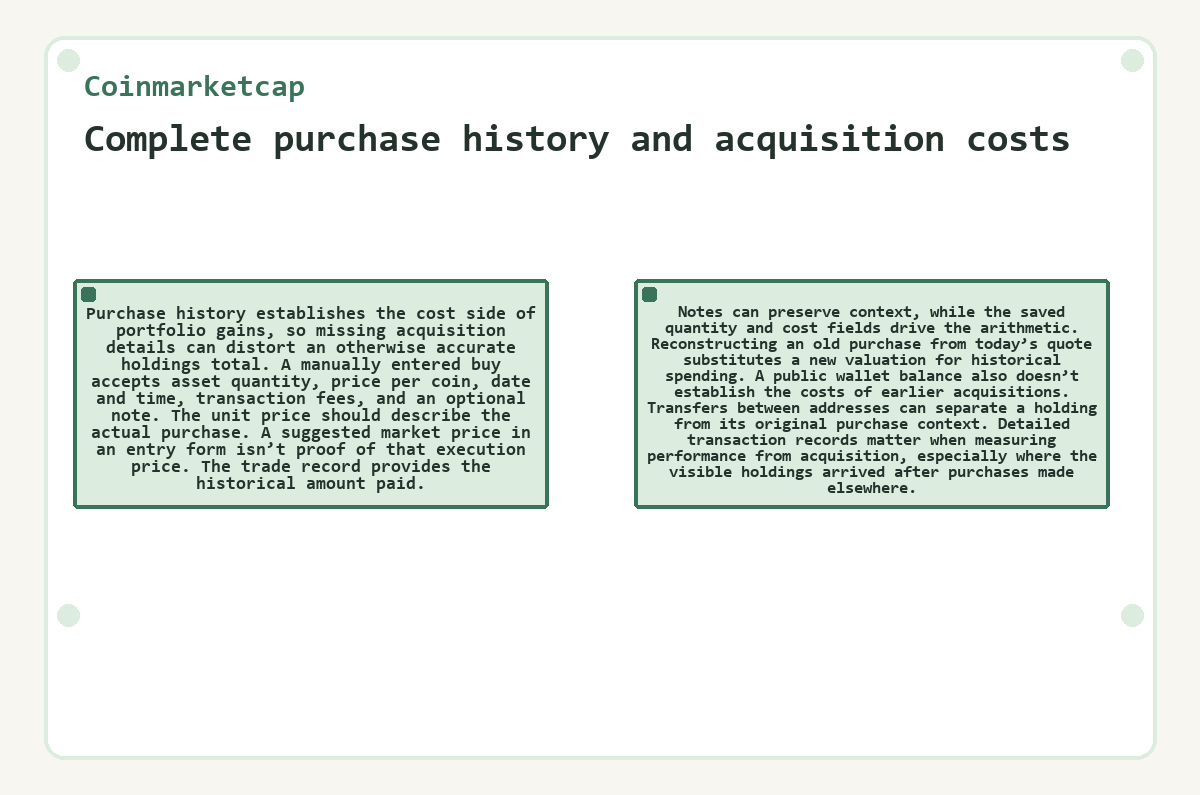
Reconstructing an old purchase from today’s quote substitutes a new valuation for historical spending.
A public wallet balance also doesn’t establish the costs of earlier acquisitions. Transfers between addresses can separate a holding from its original purchase context. Detailed transaction records matter when measuring performance from acquisition, especially where the visible holdings arrived after purchases made elsewhere.
Average buy price and fee-inclusive cost
Average buy price excludes purchasing fees, while average buy cost includes them in the amount allocated to each purchased unit. The price average divides purchase spending by total quantity bought. The cost average adds buying fees before that division. Recorded buying fees are included in the portfolio tracker’s acquisition cost basis. Both averages weight each purchase by the quantity bought. Simply averaging the listed entry prices gives a different answer when quantities differ. A market price above average buy price can remain below average buy cost, leaving a fee-adjusted loss on the holding.
Realized profit after a recorded sale
Realized profit records the gain or loss attributable to a sale after acquisition costs and selling fees are deducted from proceeds. Gross proceeds equal unit sale price multiplied by quantity sold. The calculation then subtracts the average buy cost assigned to those sold units and the sale fee. A large incoming amount can include recovery of the original spending, so gross proceeds and profit answer different questions. Acquisition fees already belong in buy cost. Deducting those same fees separately again would count the expense twice.
A recorded sale concerns the sold quantity. The remaining units contribute separately to the portfolio’s unrealized figure.
Unrealized profit and the remaining holdings
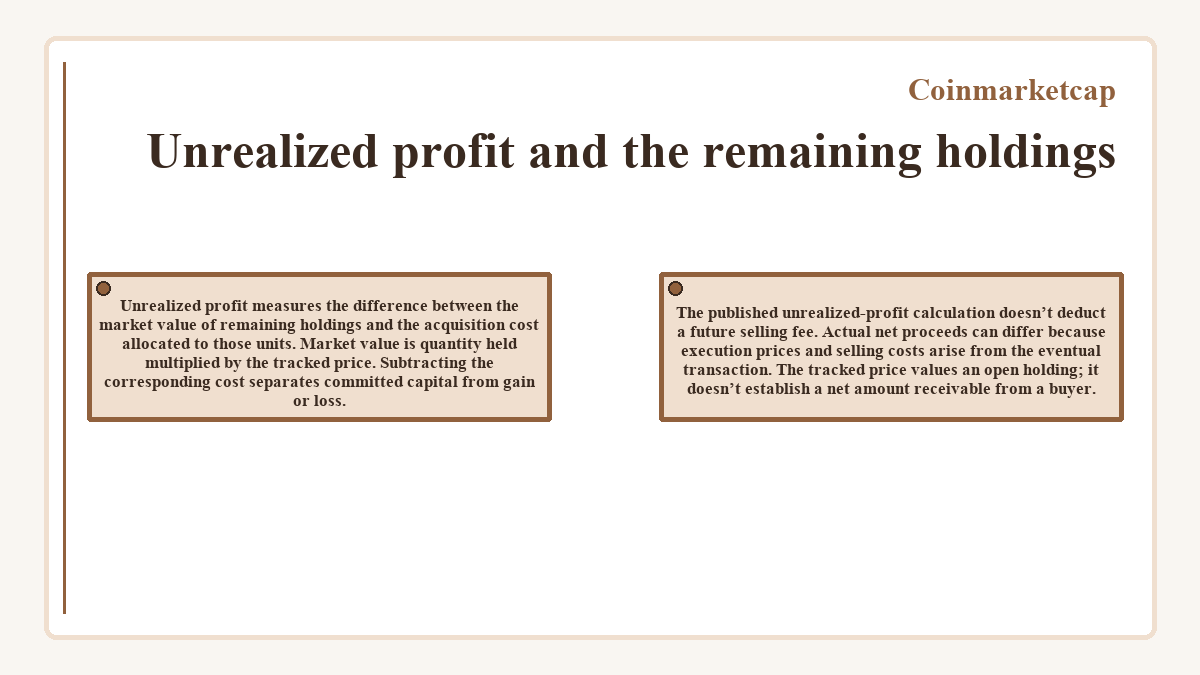
Unrealized profit measures the difference between the market value of remaining holdings and the acquisition cost allocated to those units. Market value is quantity held multiplied by the tracked price. Subtracting the corresponding cost separates committed capital from gain or loss. The published unrealized-profit calculation doesn’t deduct a future selling fee. Actual net proceeds can differ because execution prices and selling costs arise from the eventual transaction. The tracked price values an open holding; it doesn’t establish a net amount receivable from a buyer.
All-time profit and its percentage basis
All-time profit combines realized profit from recorded sales with unrealized profit on remaining holdings. Gains from sales can offset losses on open positions, or the reverse. Comparing current holdings value with all historical spending alone omits sale proceeds. That shortcut can misstate performance once parts of the portfolio have been sold.
Profit and loss percentage, or P&L%, expresses that combined gain or loss relative to the recorded acquisition cost basis.
Dividing all-time profit by that cost basis gives the return ratio; expressing it as a percentage uses the same denominator. Where each asset has a nonzero recorded cost, its contribution is weighted by that cost. Simply averaging individual return percentages loses those weights. A zero cost basis makes the division undefined. An incorrect basis can distort both the profit amount and the percentage.
Transfer entries and missing acquisition history
Transfer entries change recorded holdings without serving as new purchases or sales, which makes earlier acquisition history important for incoming assets. A transfer in records receipt, without documenting what the assets originally cost. A transfer out removes quantity from the tracked holdings without itself recording sale proceeds. Neither movement establishes a realized gain from a sale. Moving assets between your own wallets also preserves ownership. Assets can leave one tracked holding while remaining yours elsewhere. A transfer-only record therefore needs its acquisition context before the displayed profit can describe the full investment history.
Why can my profit change when I haven’t traded?
Unrealized profit changes with market prices, and all-time profit can move with it even when the recorded quantities and transaction history stay unchanged. Two views captured at different moments can use different quotes for the same holding. The historical purchase price should remain tied to the actual trade. Replacing that input with a live quote would alter the cost reference. Data lags or external data errors can also create discrepancies between displayed valuations.
The line and allocation charts can take time to recalculate historical balances after you add or edit a transaction. A temporary chart discrepancy after an edit doesn’t establish that the saved purchase cost is wrong. Repeatedly altering correct entries to chase a changing chart can distort the transaction history.
Reconcile a purchase-cost mismatch
An unexpected gain or loss after a recorded purchase calls for inspecting the saved transaction against the original purchase record before changing its cost fields. The expected entry matches the purchased quantity, execution price, and fee. Inspecting those fields leaves the record unchanged. Keep the existing values available before making a correction.
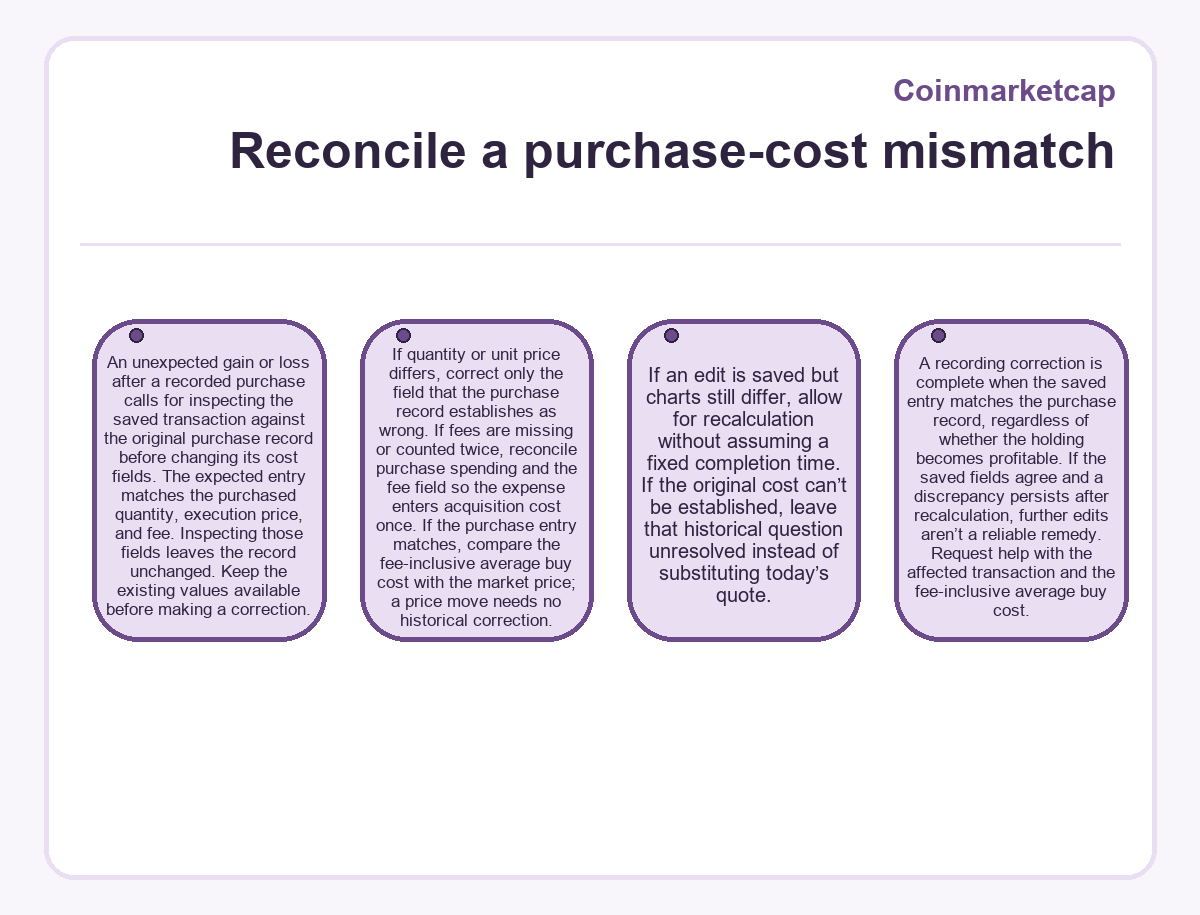
- If quantity or unit price differs, correct only the field that the purchase record establishes as wrong.
- If fees are missing or counted twice, reconcile purchase spending and the fee field so the expense enters acquisition cost once.
- If the purchase entry matches, compare the fee-inclusive average buy cost with the market price; a price move needs no historical correction.
- If an edit is saved but charts still differ, allow for recalculation without assuming a fixed completion time.
- If the original cost can’t be established, leave that historical question unresolved instead of substituting today’s quote.
A recording correction is complete when the saved entry matches the purchase record, regardless of whether the holding becomes profitable. If the saved fields agree and a discrepancy persists after recalculation, further edits aren’t a reliable remedy. Request help with the affected transaction and the fee-inclusive average buy cost.
Everyday questions about Coinmarketcap
Is the portfolio profit figure a completed tax calculation?
The portfolio’s profit figure isn’t a completed tax calculation. Its acquisition costs and sale records can supply useful information, but tax reporting has its own jurisdiction-specific rules. An average-cost performance figure doesn’t establish which accounting treatment applies to a return. The underlying transaction records remain distinct from the tracker’s performance summary.
Does a portfolio screenshot prove that someone earned the displayed gain?
A portfolio screenshot doesn’t prove that someone earned the displayed gain. Users can enter holdings, acquisition prices, and sales manually, so the image can reflect invented records. It also doesn’t establish that assets were sold or proceeds received. A screenshot accompanying a paid trading pitch provides no independent proof of that pitch’s results.
Can I separate acquisition records into different portfolios?
Coinmarketcap supports multiple portfolios on the website and mobile app. Separate records can keep groups of holdings apart, with each portfolio’s gains depending on the transactions included in it. The acquisition history needs to match the holdings recorded in each portfolio.
Why can’t I withdraw the realized profit shown in my portfolio?
The tracker holds records rather than a withdrawable balance. Its realized-profit figure describes the outcome calculated from recorded sales; entering a sale doesn’t execute it or collect its proceeds. Funds remain with the actual account or wallet that holds them. A request to pay someone to release a tracker balance misrepresents that feature.
What does privacy mode hide when I review my portfolio?
Privacy mode hides displayed values such as the total balance and individual asset holdings while you review the portfolio in a public setting. It doesn’t delete acquisition records or change the costs used to calculate realized and unrealized gains.
Will my purchase records appear in the mobile app?
Portfolio data syncs between the website and the mobile app when you use the same account. The app is available on iOS and Android. Keeping the same account and selected portfolio matters when comparing purchase records across devices. Matching records can still produce changing unrealized values because the market price moves.