 Coinmarketcap
Coinmarketcap watchlist organizes starred crypto assets in saved lists
· last updated
Coinmarketcap watchlist keeps starred crypto assets together in a saved list. Stars on market listings add assets to the list designated as Main. Account-based lists sync between the website and mobile app when you’re signed in to the same account. Each entry represents an asset that you follow; it doesn’t record a purchase, a token balance, or your acquisition cost.
Starred assets and saved lists
A watchlist combines a saved asset selection with market data columns, making the selected projects easier to monitor together. Several lists separate research interests. The mobile watchlist also works without an account, while signing in to the same account enables sync between the website and app. The portfolio records quantities and acquisition costs when personal profit is the question. A watchlist’s percentage changes describe the listed asset’s market movement, so a rising row doesn’t establish your own return.
Where do coins go when I click the star?
A star selected on the cryptocurrency listings page adds that asset to Main, the account’s designated default watchlist. The list that you last viewed isn’t necessarily that default. An entry missing from a custom collection can therefore reflect a different destination.
The Main designation
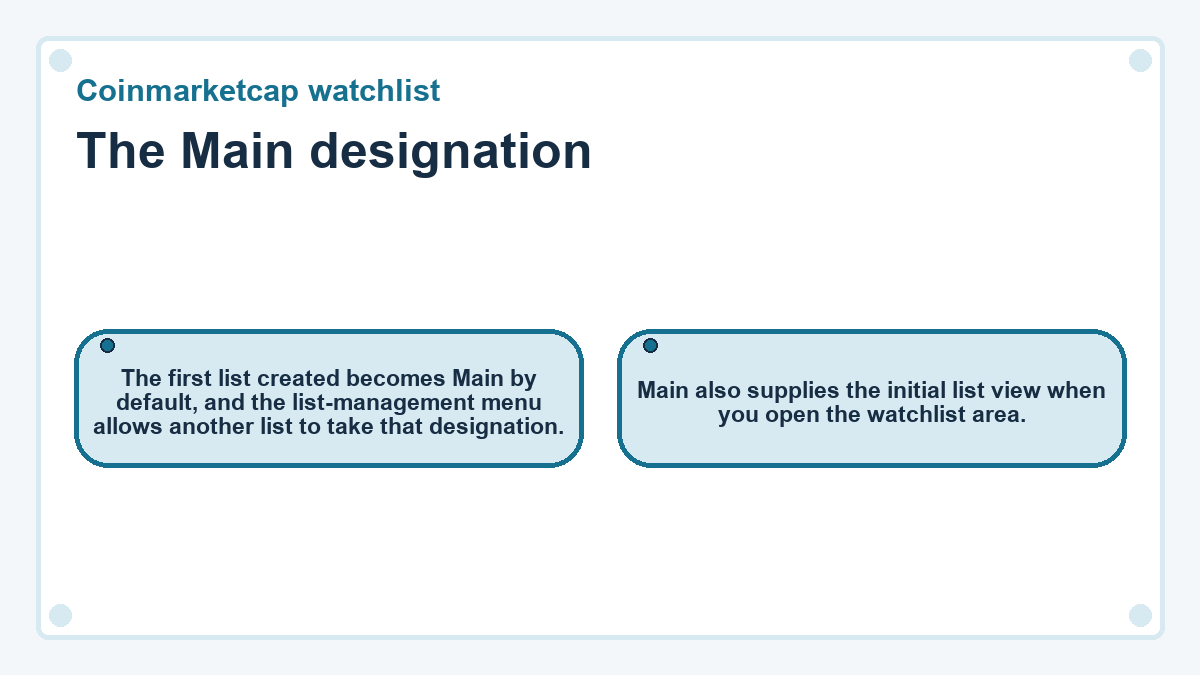
The first list created becomes Main by default, and the list-management menu allows another list to take that designation. Main also supplies the initial list view when you open the watchlist area.
Adding within a selected list
The watchlist’s Add Coins control opens an asset search from the list view. That provides an entry point for building a selected collection, alongside stars on listings and asset detail pages. Check the collection name when organizing a custom list, because the listing-page star’s default destination remains Main.
The selected collection’s asset rows establish which coins it contains. Clear collection names distinguish research groups when their selections overlap.
List settings and access conditions
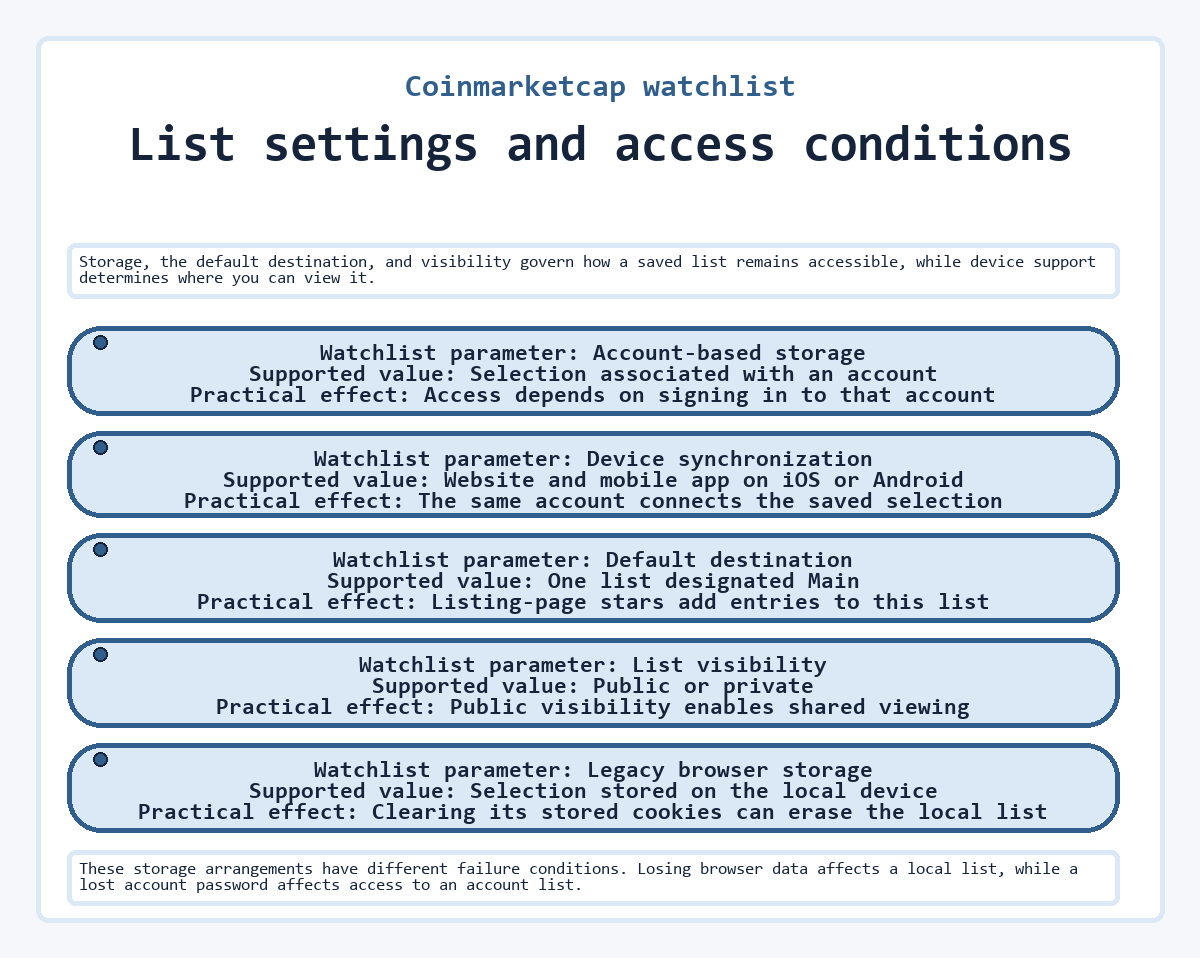
Storage, the default destination, and visibility govern how a saved list remains accessible, while device support determines where you can view it.
| Watchlist parameter | Supported value | Practical effect |
|---|---|---|
| Account-based storage | Selection associated with an account | Access depends on signing in to that account |
| Device synchronization | Website and mobile app on iOS or Android | The same account connects the saved selection |
| Default destination | One list designated Main | Listing-page stars add entries to this list |
| List visibility | Public or private | Public visibility enables shared viewing |
| Legacy browser storage | Selection stored on the local device | Clearing its stored cookies can erase the local list |
These storage arrangements have different failure conditions. Losing browser data affects a local list, while a lost account password affects access to an account list.
Why is my watchlist missing on another device?
A watchlist can appear missing when the devices use different accounts, another list is selected, or an older local selection wasn’t migrated into the account.
Account and list selection
Account-based watchlists sync between the website and mobile app when both use the same account. The account identity and selected list need to match before the screens can be meaningfully compared. An empty Main list doesn’t establish whether another named collection still contains the assets.
For accounts registered with an email address and password, password recovery uses the registered email. The website sends a reset link, while the mobile app sends a verification code. Restoring sign-in access addresses an authentication problem. It doesn’t itself recover entries deliberately removed from a list. Keep the registration method in mind; email-password recovery isn’t interchangeable with every other sign-in option.
Legacy browser selections
Older watchlists could exist solely in browser storage. Removing the cookies that held that selection could remove the list, even if crypto prices still appeared normally. That limitation belongs to local storage. Account synchronization provides access across devices, so losing the original browser and losing an account’s saved selection are different problems.
The older migration flow distinguished the local selection from the account selection. Its merge option combined both lists; keeping only one discarded the other. If that migration prompt appears, inspect the meaning of its choices before choosing. The discarded data couldn’t be restored through that migration flow, so the choice had a different consequence from simply changing devices.
Private lists and public sharing
A public watchlist makes its selected assets visible to other viewers, while a private list limits viewing to its owner within the service. Shared viewing depends on the visibility setting. Distributing a link to a private list doesn’t make its contents public.
Names and descriptions help identify each collection. They also form part of what you choose to disclose when sharing a public list. Avoid placing personal contact details or unrelated private information in these fields. A public selection can reveal research interests, even when it says nothing about a wallet’s token balances or ownership.
A screenshot remains a separate copy of what someone could view when it was captured.
Price change columns and notifications
Customizable watchlist columns can display price, market capitalization, and percentage changes over periods such as one hour, 24 hours, or seven days. Read the period together with the percentage. Different periods describe different stretches of market movement, and the change isn’t calculated from the moment you starred the asset. Keeping the same columns visible helps compare list entries on the same basis.
Watchlist movement notifications report significant increases or decreases for coins in the list. Individual price alerts are a separate mobile-app setting. The general watchlist notification category doesn’t establish a personal target price, and its label doesn’t specify a universal trigger percentage. Notification preferences determine which messages you request.
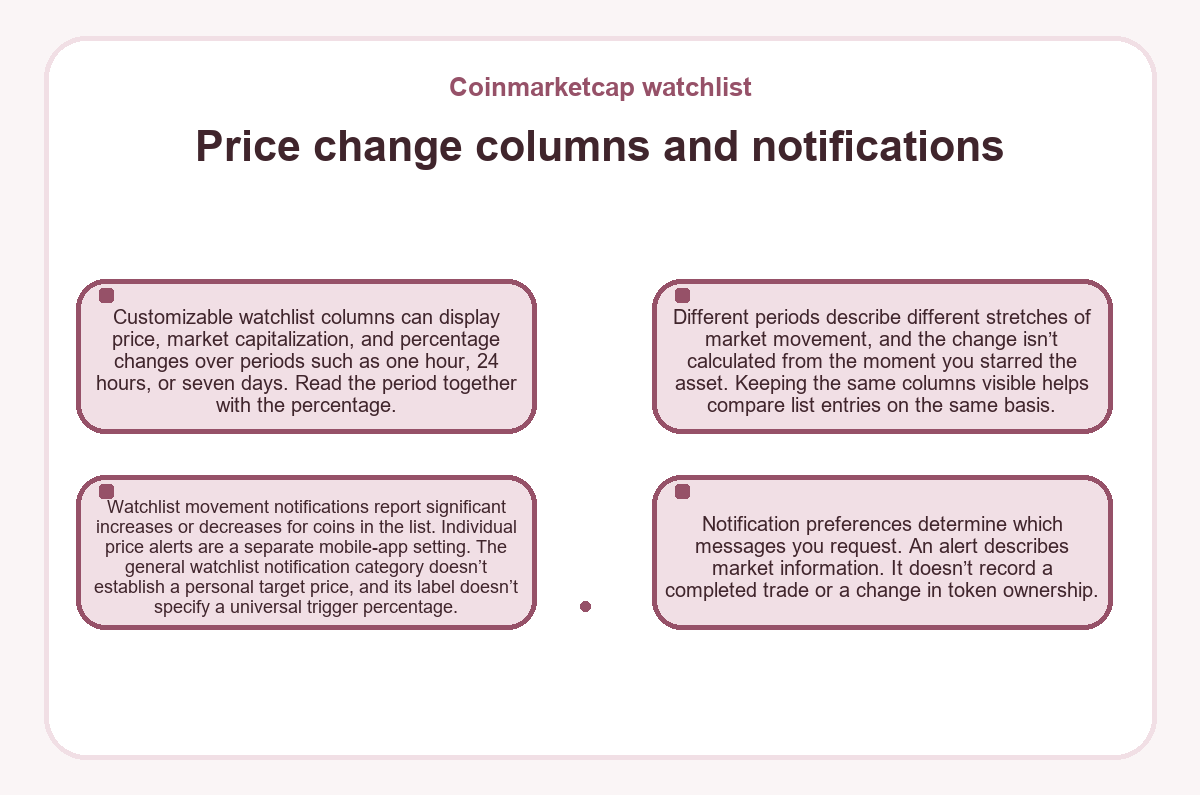
An alert describes market information. It doesn’t record a completed trade or a change in token ownership.
Coinmarketcap watchlist: frequently asked questions
Is the watchlist available without a paid subscription?
The standard watchlist is free to use. An account is needed for saved account-based lists and desktop-to-app synchronization. That account requirement is separate from paid data services or other subscription products; using the ordinary watchlist doesn’t require buying a market-data plan.
Can I duplicate a watchlist before editing its contents?
The list-management menu includes a copy or duplicate option. A duplicate provides another list that you can organize separately. It remains part of the account’s watchlist features, so copying a list shouldn’t be treated as an external backup or a guarantee that deleted account data can be recovered.
Does removing a watched coin sell any tokens?
Removing a watched coin changes the saved asset selection. It doesn’t submit a sale or move tokens from a wallet.
Can I follow a public watchlist while keeping my own list private?
You can follow public watchlists while your own lists remain private. Your list’s visibility setting governs access to that list; it doesn’t prevent you from viewing or following a public collection. Following someone’s selection also doesn’t record a purchase of the coins they track.
Where can I switch off watchlist movement notifications?
Watchlist movement notifications can be switched off in the account’s notification settings. On the website or mobile app, open your profile settings and go to Notifications. Turning off that category changes the alerts you receive; it doesn’t remove the saved assets from your list.
Should I delete my account to fix a watchlist display problem?
Account deletion is irreversible once completed, so it isn’t a routine display fix. Check the signed-in account and selected list first. Recovering access to an existing account and creating a replacement account are different actions; a new account doesn’t undo completed deletion. While deletion is pending, you can ask support to cancel. Processing takes about 21 days for website requests or 28 days for mobile-app requests.